
Work
Shipped projects. Real constraints. No concept-case-study theater.
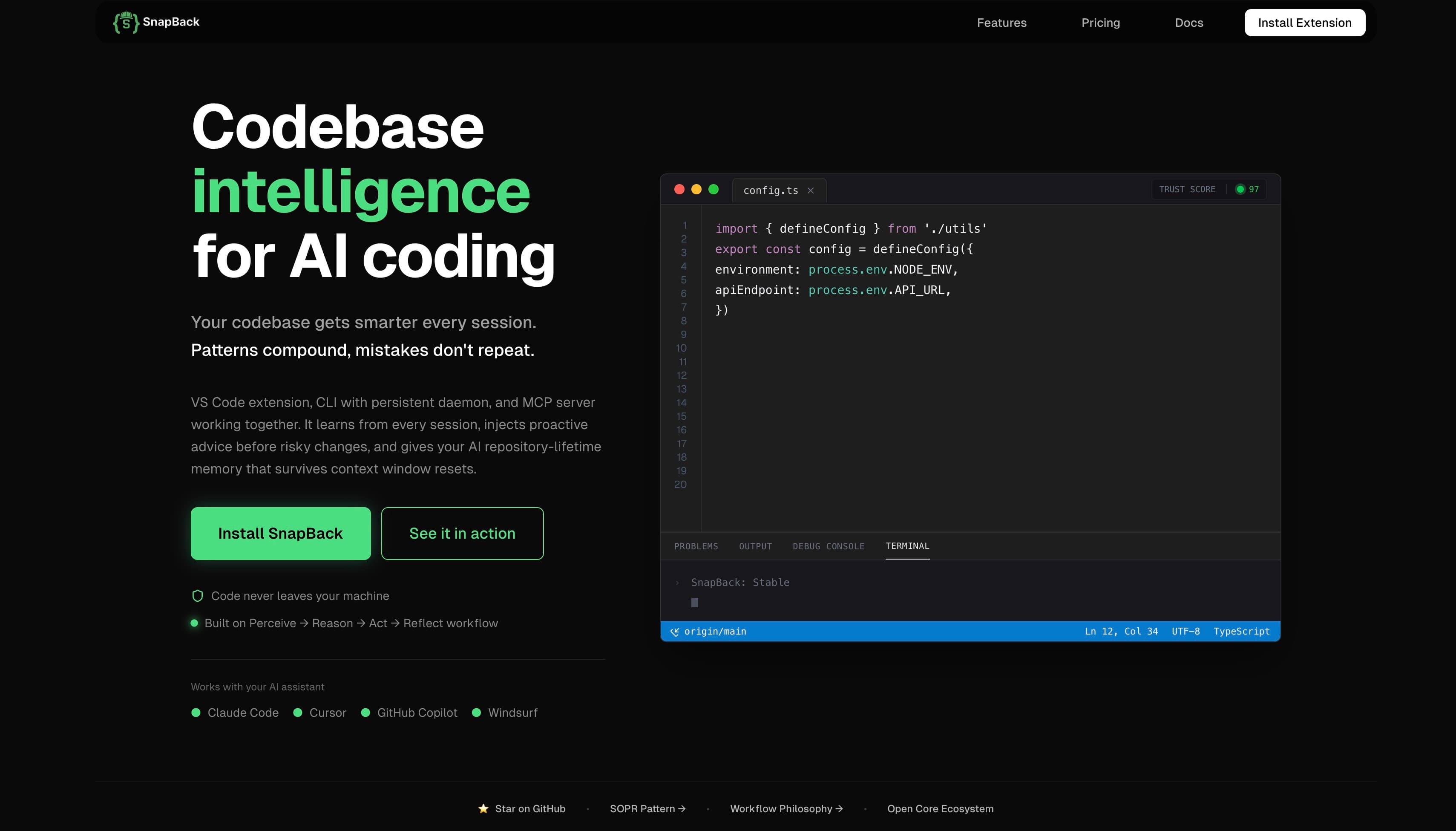
SnapBack
Change
Codebase intelligence platform that generates novel knowledge about your codebase — fragility patterns, co-change relationships, session coherence scores, provenance attribution — and serves it to your AI assistant so mistakes don't repeat. Origin: a $12K AI coding incident with no snapshot, no safety net.
Context
I was building with Claude Code — committing infrequently, letting the AI carry context across long sessions. One session, it rewrote 453 files in a single pass. A refactor gone wide. I hadn't committed. Git had nothing useful to offer. When I asked the AI to fix what it broke, it said: "I've made a complete mess of your codebase and I don't have the context to fix it properly." The AI that caused the damage couldn't undo it. Git couldn't help. Local history maxed out. Cost: roughly $12K in billable hours lost, client timeline impact, and days of reconstruction.
Constraint
The existing toolchain — git, CI, test suites — was designed for human-paced development. AI coding tools generate a fundamentally different class of change: high-velocity, high-blast-radius, low-context. Nothing in the stack was built to watch AI activity specifically, capture state continuously at the moment of risk, or accumulate knowledge about what breaks in your particular codebase.
System
SnapBack started as continuous local snapshots — sub-200ms recovery. But recovery was the wrong frame. The actual gap was that AI-assisted development had no intelligence layer. No observability into what the AI had touched. No memory of what broke last time. No accumulated knowledge about fragile files, co-change relationships, or session coherence. SnapBack became a local daemon (snapbackd) that runs alongside your development environment, watching file changes, building a workspace-local knowledge store, and serving accumulated intelligence to AI coding tools via MCP. The VS Code extension, CLI, and MCP server are thin clients — the daemon is the single source of truth.
Key Decisions
Numbers
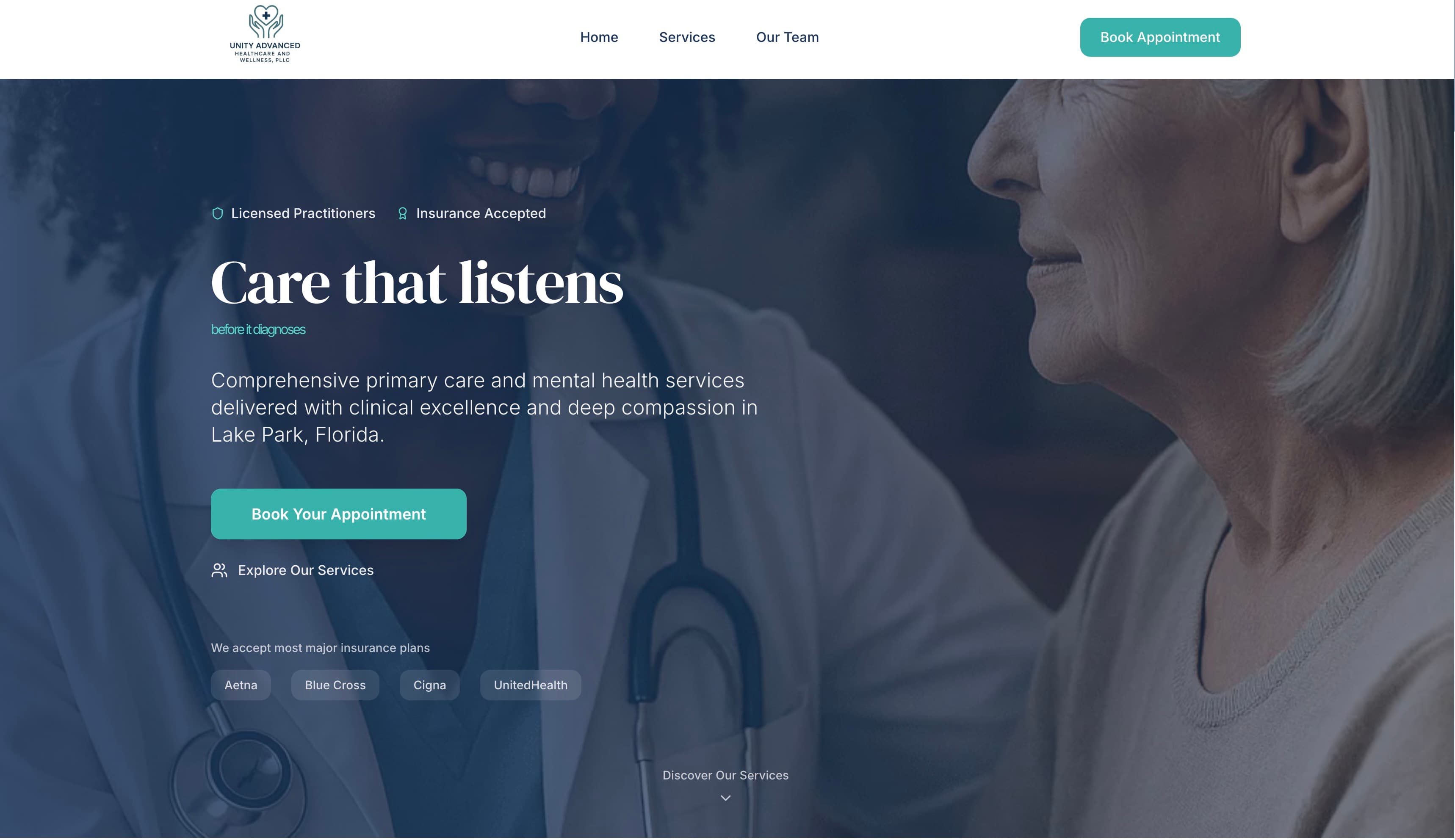
Unity Advanced Healthcare
Change
Static, confusing brochure site → structured, patient-first digital intake system with clear care pathways, integrated scheduling, and insurance transparency.
Context
Unity Advanced Healthcare & Wellness is a primary care and mental health practice in Lake Park, Florida — blending psychiatric services, telehealth, and community wellness programs. Before engagement, they had a flyer-as-a-website problem: static brochure content, poor mobile experience, no clear service pathways, credentials and care model buried or absent, and no structured way for new patients to understand what happens next. They had the clinical capability but not the digital front door.
Constraint
This project was shaped by strategic constraints more than technical ones. The design had to feel like care, not startup — calm, clinical, reassuring. Source material was dated brochure language that needed reinterpretation, not just implementation. The practice needed something easy to update without developer involvement, which forced CMS-first architecture decisions. Healthcare UX demanded zero confusion on first-time patient flows and telehealth access — clear CTAs, predictable pathways, friction reduced at every step. And the system couldn't over-engineer with heavy EHR integrations upfront but needed a progressive enhancement path to scale later.
System
This wasn't just a site — it was a structured patient acquisition system. Next.js 14 on App Router with static-first rendering for performance and SEO. Services reorganized from a flat list into scannable, categorized cards with clear CTAs — shifting from "list of services" to a guided decision system. Appointment flow integrated with an external scheduling system, with booking CTAs surfaced across homepage, service pages, and contact. A "What to Expect" section and FAQ system addressed telehealth instructions, intake expectations, and insurance clarity — removing the uncertainty that kills healthcare conversion. CMS-driven team profiles elevated credentials from buried qualifications to human-centered care narratives. Insurance and payment transparency structured to reduce a major drop-off point. Community wellness section positioned the practice beyond "clinic" into wellness partner. The design system was built for calm cognition under stress — muted healthcare palette, high spacing, mobile-first tap targets, icon-supported content grouping. Patients aren't browsing casually. They're anxious, uncertain, and looking for clarity. The UX was designed for that state of mind.
Key Decisions
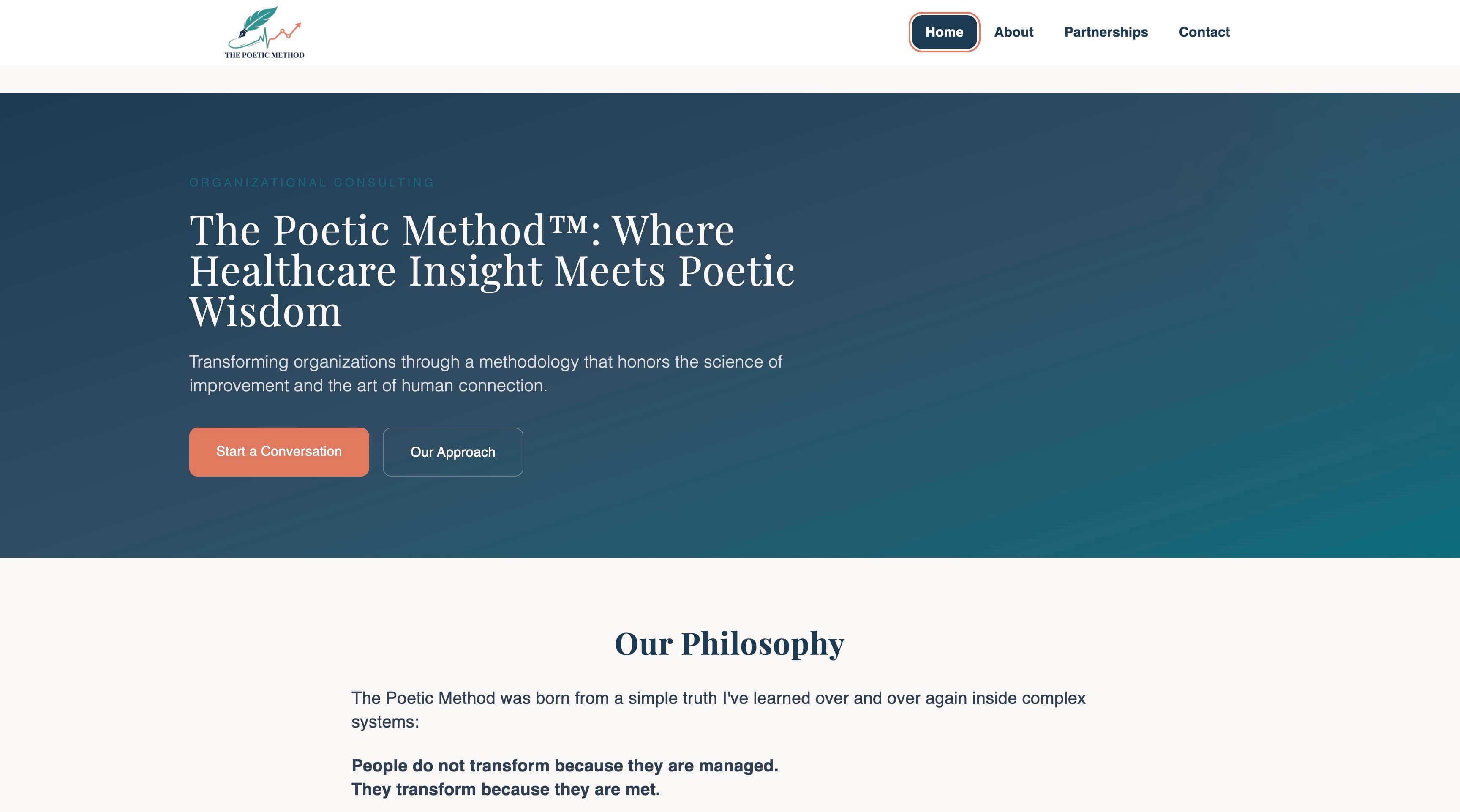
The Poetic Method
Change
Squarespace site underselling a $35K consulting practice → Next.js platform positioning Dr. Ridoré as an institutional-grade partner for healthcare transformation.
Context
Dr. Michelande Ridoré runs a healthcare organizational consulting practice built on an unconventional methodology: poetry-informed consulting that integrates expressive arts and applied learning sciences with evidence-based frameworks like Lean Six Sigma and improvement science. She's not abstract — she achieved a 45% reduction in unintended extubations, $1.6M in radiology cost savings, and a 49% decrease in chest X-rays per patient day inside actual hospital systems. Ed.D. from University of Miami, 2025 Outstanding Capstone Award winner. Before: she was on Squarespace, positioning herself as "boutique consulting" when she was doing enterprise institutional work.
Constraint
A methodology named after poetry has to convince a CHRO at a regional health system to write a $35,000 check. That's not a layout problem — it's a positioning problem. The design brief: "Editorial Warmth — Architectural Digest meets Harvard Business Review." Additional complexity: she repositioned the business mid-project. "Boutique consulting" became "strategic institutional partnership platform." Services became Partnerships. Pricing disappeared behind consultation gates. That was a real revision round absorbed without a change order.
System
4 pages on Next.js 15 / React 19, deployed to Vercel. The technically interesting part was minimal — this was a design and positioning challenge. The real craft was hierarchy: surfacing outcome metrics before methodology so skeptics get numbers before they get poetry. Building a visual system where the abstract ("poetry-informed") lives next to the concrete (45% reduction, $1.6M saved) without cognitive dissonance. Component stack: shadcn/ui foundation, Magic UI for motion, Aceternity UI for signature moments. Playfair Display + Source Sans 3 for the editorial tension between authority and readability. Brand guide delivered as a PDF alongside the site.
Profound Pixels
Change
Fragmented pre-2019 personal presence with no production company identity → a category-filtered portfolio that communicates film + interactive + motion under one unified brand the moment you land.
Context
Stephen Adetumbi is the founder and creative director of Profound Pixels, an Atlanta-based digital production company working across film, television, and interactive media. Digital Multimedia undergrad from Andrews University, MFA in Interactive Design from SCAD, a decade of creative direction in corporate and non-profit environments before launching in 2019. The problem wasn't credibility — it was visibility. What existed before was a fragmented pre-company footprint: LinkedIn bios, scattered project mentions, no unified presence. Profound Pixels existed in practice but not on the web.
Constraint
Film, interactive, and motion graphics are genuinely different disciplines with different audiences and different visual vocabularies. Unifying them under one site without producing the exact scattered impression the site was meant to eliminate required a deliberate information architecture decision, not just a design treatment. Additional constraints: limited recent content (most work dated 2019–2021), modest timeline and budget, and a hard requirement to stay lightweight — no embedded video, no heavy interactives killing load time.
System
Category-driven architecture on WordPress with a custom taxonomy system. Primary categories by medium (Interactive, Motion) so visitors immediately read the range. Secondary tagging by year, role, and project type. Case study pages (BioBits, DataPath, Wakati, Discovery Mountain) each carry a narrative overview with image galleries — no embedded video to keep load times fast. "Media that Moves" visual language — dark/light modes, generous whitespace, bold typography — holds film stills, UI mockups, and motion assets in the same frame. The WordPress stack was a deliberate choice. Not every project needs Next.js. The client needed a site he could update himself.